Reflections on the Mandela Memorial Service

Tuesday 10th December 2013 saw the Memorial Service for Nelson Mandela held at the FNB stadium on the outskirts of Soweto. Rather unexpectedly, on my part at least, this became a more overtly political event than I was anticipating. Domestic South African politics was definitely not put on hold for the duration of the service. Most notably there were repeated choruses of loud boos aimed at current South African President, Jacob Zuma, from significant sections of the crowd. The biggest cheers seemed to be reserved for Barack Obama but interestingly, former South African President, Thabo Mbeki, was also well received. As a result the MC for the event and Deputy President of the African National Congress (ANC), Cyril Ramaphosa, repeatedly called for discipline from the crowd. Then towards the end of the service, when many had already left the stadium, Desmond Tutu showed his frustration at what he presumably thought was inappropriate behaviour for such an event. A news story in the South African press also suggests that the public broadcaster (SABC) was instructed to ‘cut away’ to try and hide the booing of Zuma.

So why did sections of the crowd react to Zuma in such a fashion? From watching on TV it was clear that some small elements of the crowd were clearly supporters of Julius Malema’s new political party (Economic Freedom Fighters). However, interviews with some members of the crowd broadcast on the BBC World Service suggest those booing came from a much wider constituency. Another report also suggested that sections of the crowd dressed in ANC colours joined in with the booing of Zuma.

So it seems the boos may have reflected a wider sense of disappointment with the performance of the current government and Zuma in particular. Some of the interviewees made direct reference to the accusations of corruption surrounding the upgrade to Zuma’s Nkandla homestead. South Africa’s Mail and Guardian recently published details of the core findings of the public protector’s provisional report on the so-called security upgrades to his home in KwaZulu-Natal, which suggests that the costs escalated from an original estimate of R27 million to R215 million. The provisional decision of the report is that Zuma will have to repay the state and face questions in parliament.

During the post-apartheid era, given that the ANC has been the main route to political power, much of the most significant debate has taken place within the party. In this sense, rifts within the ANC are nothing new. Bitter divisions led to the overthrow of Thabo Mbeki at the ANC’s National Conference in Polokwane in 2007. More recently branches of the ANC within the province of Gauteng (where the memorial service was held) failed in a bid to replace Zuma with Kgalema Motlanthe as ANC President at the Manguang Conference in December 2012.

A lively debate in South Africa has resulted as to whether the memorial service was an appropriate platform for citizens to display their feelings towards Zuma. The whole event clearly had a political agenda. I am sure it was no accident, given the recent focus of South Africa’s foreign policy, that the government gave the platform to the Presidents of Brazil and India and the Vice-President of China but not a single leader from Europe. This was not a funeral and given the frustrations of many, with the lack of socio-economic development and the increase in income inequality within South Africa since 1994, it is perfectly understandable.

How did Zuma respond? He delivered a rather dispassionate account of the familiar history of Mandela’s role in the struggle against apartheid. South African comedian, Trevor Noah, tweeted “did someone write this speech or is Zuma reading a Wikipedia page?”. There was precious little on the way forward for South Africa and in general it highlighted his significant limitations as a leader.

Does this all mean that the ANC will struggle to win the April 2014 election? In a word, no. However, there is clearly a rising tide of dissatisfaction within South Africa if levels of protest, as measured by police statistics, are a reliable indicator. South African academic, Peter Alexander, has called this the ‘rebellion of the poor‘ but what is interesting is that in an academic article published in 2010 he concluded that there was ‘no evidence that Zuma, or the ANC in general, were held responsible for people’s problems’ (Alexander 2010, p. 34)*. Maybe events on Tuesday suggest that the tide is beginning to turn. Nevertheless, an alternative ruling party remains a rather distant prospect.

* Alexander, P., 2010. Rebellion of the poor: South Africa’s service delivery protests – a preliminary analysis. Review of African Political Economy, 37 (123), 25-40.
World Trade: Ten Years On From Cancún

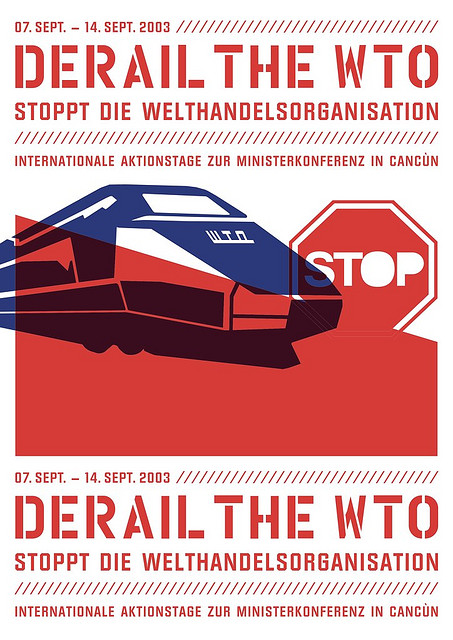
Image by Global Justice Posters

It was ten years ago today that talks at the Ministerial Conference of the World Trade Organization (WTO), held in Cancún, Mexico ended in deadlock. Member states could not agree a consensus mainly due to a lack of movement by the developed world on agricultural subsidies and their insistence on the inclusion of new trade issues. At the time, many development campaigners and a number of negotiators from the developing world celebrated the fact that the world’s leading trade powers had failed in their attempt to push for agreement on the so-called ‘Singapore Issues’.

Did this represent the increased activism of developing states in global trade? What has happened during the decade since Cancún?

A week after the Conference in September 2003 Robert Zoellick, then US trade representative, wrote in a piece for the Financial Times that,

“the key division at Cancún was between the can-do and the won’t-do. For over two years, the US has pushed to open markets globally, in our hemisphere, and with sub-regions or individual countries. As WTO members ponder the future, the US will not wait: we will move towards free trade with can-do countries”.

With hindsight it appears that such comments were not simply diplomatic rhetoric. What we have witnessed since 2003 is a shift in the approach of the established trade powers. They have moved towards a focus on bilateral and regional trade agreements with developing countries and emerging markets, in particular, rather than multilateral negotiations within the WTO.

The European Union (EU), in particular, has embarked on numerous bilateral trade negotiations in recent years. As of August this year the European Commission reported that it has 29 trade agreements in place and is currently negotiating with Japan, the US, Canada, Malaysia, Vietnam, Thailand, Morocco, India, Mercosur (regional grouping in Latin America), Moldova, Armenia, Georgia, Ukraine, Costa Rica, El Salvador, Guatemala – to name but a few!

Particularly contentious for many development NGOs has been the negotiation of Economic Partnership Agreements (EPAs) with African, Caribbean and Pacific (ACP) states, which has allowed the EU to include at the bilateral level many of the issues that developing countries had resisted at Cancún. The power asymmetry between the EU and the ACP sub-regions involved in the EPA negotiations has enabled them to determine the key aspects of the negotiating agenda. The EU has pursued a ‘deep integration’ approach to its trade negotiations aiming to secure FTAs that go beyond simply the liberalisation of trade in goods.

This has meant the re-introduction of the ‘Singapore Issues’ onto the negotiating table. They refer to the inclusion of investment, competition policy, government procurement and trade facilitation measures. Their introduction (except trade facilitation) would mean that European firms would have to be treated in the same way as any domestic provider. This would pose significant limits to the range of development strategies available given that regulatory policy, previously the preserve of national politics, would become part of the FTA. In particular it would prevent the adoption of an active industrial policy. The introduction of these behind-the-border issues would also create a harmonisation of the business environment in line with the liberal model adopted in Europe, which would be of benefit to European business sectors looking to invest in partner countries.

In essence, what the last decade has revealed is that the focal point of the trade liberalisation agenda has shifted away from the WTO to bilateral trade negotiations. For those of us who seek to resist the neoliberal free trade agenda we must be careful what we wish for!

* A much more detailed (and considered!) elaboration of some of the arguments presented here can be found in Stephen R. Hurt (2013) ‘African agency in world trade undermined? The case of bilateral relations with the European Union’ in William Brown and Sophie Harman (eds), African Agency in International Politics, Abingdon: Routledge, pp. 49-64.

The Marikana Massacre: One Year On

Can it really be a year since the fatal shooting by the police of 34 striking miners at Lonmin’s platinum mine in Marikana, South Africa? The shocking events captured by TV cameras made headline news around the world at the time. A memorial service was held on Friday 16th August 2013 to mark the anniversary of the massacre. At the time, comparisons were made to the Sharpeville shootings of 1960, which was one of the defining incidents of the apartheid era. In making such a comparison the implication is that Marikana was an event that will ultimately change the course of South African history. For example, eNCA’s documentary ‘The Marikana Massacre: Through the Lens’ introduces it as “a story that changed South Africa forever”. Now that the initial international outrage has passed, what has happened since? What are the legacies, if any, of the Marikana massacre? Has anything changed since this use of lethal force by the post-apartheid state?

Marikana
(Image: Jared Rodriguez / Truthout)

An obvious place to start is the ongoing Farlam Commission of Inquiry, which began its investigations in October of last year. It has made very slow progress – not a single police officer who was present on the day of the massacre has testified as yet. Delays have also resulted from a court battle over who should foot the bill for the legal representation of the miners. Meanwhile, the relatives of the deceased are unable to pursue a civil case for compensation until the inquiry has completed its investigation. The Congress of South African Trade Unions (COSATU) did call for an alternative ‘independent’ inquiry to consider the wider impacts of the mining industry, but has not backed this up with significant efforts to push for such an investigation.

What was most remarkable about the memorial service held at Marikana last week was the absence of the ANC. This decision is related to an ongoing feud between the ANC and the Association of Mineworkers and Construction Union (AMCU) who organised the event. The ANC’s nonattendance played straight into the hands of its opponents. It was described by a BBC reporter as having the feel of an opposition rally. Julius Malema in the guise of his new political party – Economic Freedom Fighters (EFF) – was in attendance. The EFF used its platform to define the problems at Marikana within its wider narrative of the need for the nationalisation of South Africa’s mines, which is problematically offered as something of a panacea for South Africa’s poor black majority.

Part of the cause of tensions within the workforce last year was a feeling amongst a number of the miners that the National Union of Mineworkers (NUM), which is affiliated to COSATU, was failing them. As a result some began to join AMCU and since last August we have seen AMCU gain momentum to the extent that just two days before the anniversary of the massacre, it was officially recognised as the majority union at the Lonmin mine.

A year later violent clashes between the NUM and AMCU continue.

The rise of AMCU at the mine is reflective of the increasing tensions within the wider trade union movement most recently demonstrated by the campaign by some within the largest federation to discredit Zwelinzima Vavi, COSATU’s Secretary General. Support for Vavi, who has been publicly critical of Zuma’s government, has exacerbated tensions within COSATU. There is clearly an increasing disjuncture between many trade union leaders and the rank-and-file, which is compounded by the political connections that result from COSATU’s continued membership of the tripartite alliance with the ANC and the South African Communist Party (SACP). It is the questioning of this relationship with the ANC that has helped AMCU to recruit members from the NUM.

So what has changed in South Africa since last August? Apart from increased divisions within the labour movement, very little! There appears to be limited faith in the ability of the inquiry to get to the truth of what happened last year and the distrust of the ANC is part of a wider and longer-term trend of sporadic and localised protest against the lack of progress enjoyed by the majority of the South African population. The events at Marikana last year raised serious concerns over how the ANC government responds to protest and critique. It seems highly unlikely that such criticism of the government will translate into meaningful change at the ballot box in elections scheduled for next year.

UK Aid to South Africa

The UK government’s decision to stop bilateral aid to South Africa in 2015 has aroused significant controversy. As a UK taxpayer and long-time observer of all things South African I feel compelled to blog about this one! Not least because it appears that the popular view within Britain is that this was a good decision. For example, 83% of respondents to a poll on the Guardian website agreed that the UK government was right to cut aid to South Africa.

Despite the fact that official development assistance (commonly known as aid) will always remain a ‘sticking plaster’ approach to the world’s development challenges, I would still suggest this policy is problematic. Not least, it is questionable even on the UK government’s own terms. Justine Greening, the UK’s Secretary of State for International Development, justified the decision on the grounds that “South Africa has made enormous progress over the past two decades, to the extent that it is now the region’s economic powerhouse and Britain’s biggest trading partner in Africa”. However, the suggestion that South Africa is now an economic powerhouse ignores the daily reality for the majority of its citizens. Inequality, poverty and unemployment remain entrenched despite it being nearly two decades since the end of apartheid.

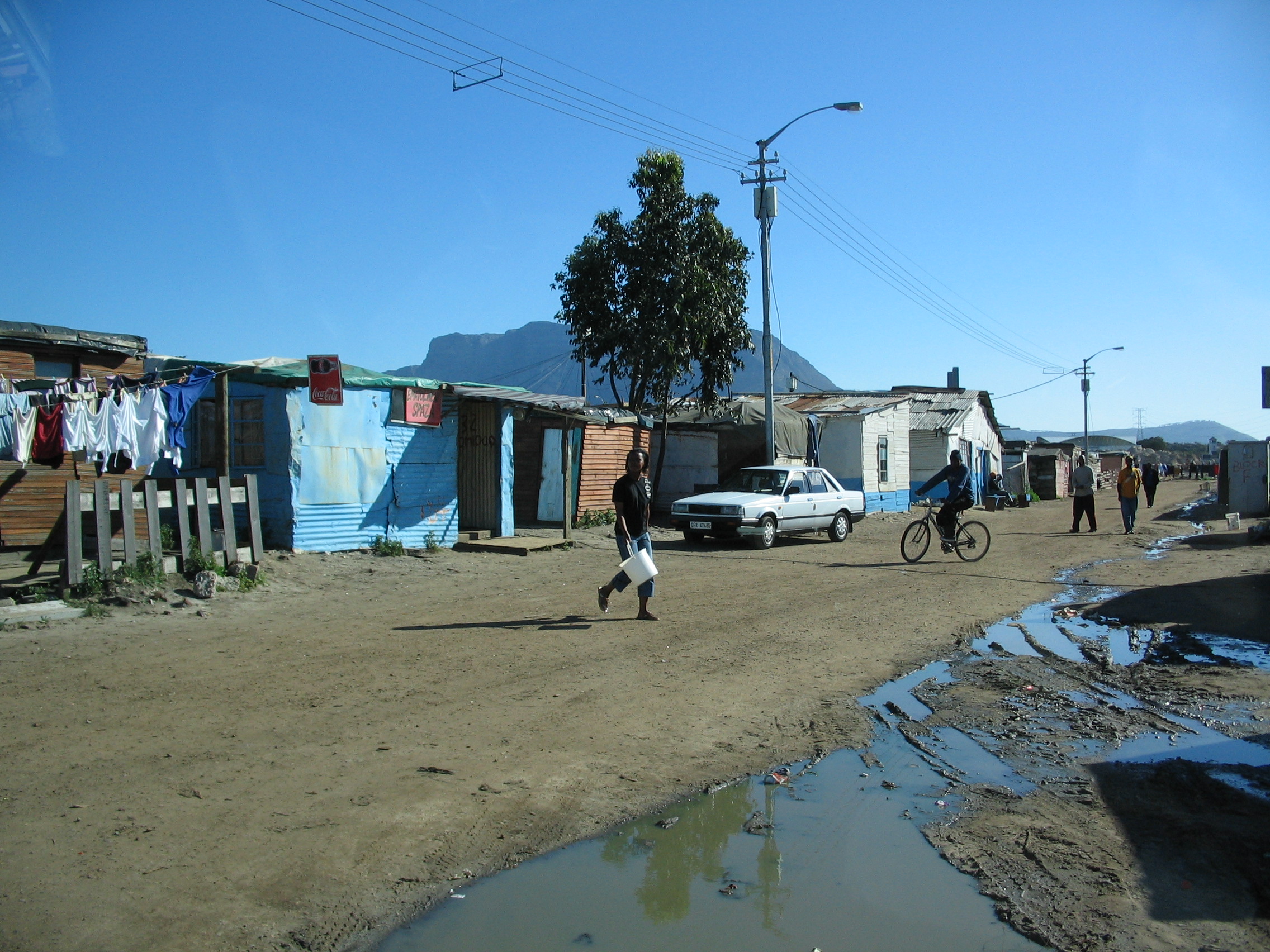
Langa Township, Cape Town, 2005.

The HIV/AIDS pandemic continues to pose a major public health challenge. According to UNAIDS 5.6 million people are living with HIV in South Africa, which translates into a prevalence rate amongst 15-49 year olds of 17.3%. It is notable that HIV projects are currently one of the central elements of the British aid programme in South Africa. As a result, the International HIV/AIDS Alliance was critical of the UK government’s decision, suggesting that “withdrawing aid to middle income countries like South Africa altogether risks seeing investment made in the HIV response to date, as well as subsequent gains including broader health outcomes, undermined and worse rendered ineffective”.

Defending the announcement, Business Secretary, Vince Cable, suggested that South Africa (along with India) had achieved a ‘successful level of development’. Hmm, really Vince?! Take, for example, the UNDP’s Human Development Index as a measure of development. We find that South Africa has made virtually no progress over recent decades: in 1990 South Africa’s HDI was 0.621 and the latest figure for 2012 is 0.629 (UNDP, Human Development Report 2013, p. 149).

UK aid to South Africa has fallen from a peak of £40-million in 2003 to its current level of £19-million. What does this mean in the overall context of UK aid spending? Well, for 2011/12 DFID’s bilateral expenditure on development was £4,204 million, so development assistance to South Africa only represented 4.5% of this. However, for me, it is less about the money itself, although this has clearly been of some benefit in some targeted aid programmes; it is more about the ideas that this pronouncement reinforces. There are three aspects of the signal this decision sends which are troubling:

  1. It reinforces the popular perception that human development is merely about rising levels of GDP at the level of nation-states. We need to conceptualise underdevelopment in human terms, rather than taking a state-centric view of the world.
  2. It implies that, despite the damage done to Southern Africa through centuries of British colonial rule, and the support provided by successive British governments to the economy during apartheid, it is now not our responsibility to try to help those who continue to suffer the consequences of the entrenched inequalities that this historical relationship has contributed to.
  3. The underlying assumption behind the decision is that the neoliberal mantra of free trade will be the route to development for countries like South Africa.

All these assumptions should be challenged!

The Legacies of Apartheid

To what extent can we blame South Africa’s current situation on the historical legacies of the past, and in particular the 46 years of apartheid rule? This is a debate that has been reignited in South Africa in recent weeks following comments made by Trevor Manuel who served as Finance Minister from 1996 to 2008. A recent speech made to civil servants by Manuel led to headlines in the South African media such as ‘Manuel says government can’t blame apartheid anymore’. The last President under white-minority rule, FW de Klerk also entered the debate and rather unsurprisingly suggested that South Africa’s current difficulties cannot be explained by reference to its apartheid past. De Klerk concluded that looking back will only ‘stir up racial animosities that we simply cannot afford’. President Zuma then responded with a clear rebuttal of such claims, by arguing that ‘to suggest we cannot blame apartheid for what is happening in our country now, I think is a mistake to say the least’.

They way this ‘debate’ has been portrayed in the media leads to a false dichotomy where we either take the view that apartheid is to blame, or that the ANC government is at fault, for all of South Africa’s current ills. To put it simply, it is difficult to sustain the argument that the continuing failure of the ANC government to effectively deliver services and a better life for the population is simply a product of apartheid and the centuries of colonial rule that predated the election of the National Party in 1948. However, if we are to adequately understand the challenges faced by the current government then an appreciation of the past remains relevant.

The legacies of apartheid and the longer history of colonial rule are clear. The appropriation of land is just one aspect that continues to shape contemporary South Africa. This year marks 100 years since a key piece of legislation, the Natives Land Act (1913), was passed by the British colonial rulers. This reserved the vast majority of South Africa’s land for the white minority. The National Party government then extended this segregation through the Group Areas Act (1950), which resulted in the forced relocation of many South Africans. This geographical and social separation of racial groups during apartheid also resulted in psychological legacies that will continue to shape people’s attitudes for years to come. Since the ANC came to power in 1994 attempts have been made to implement land reform but these have been slow, to say the least, and based on a ‘willing-buyer willing-seller’ model that has proven incapable of rectifying years of unequal land ownership.

The education system under apartheid also saw systematic discrimination of the black majority with significantly lower spending per student than that spent on the white minority. Older generations within South Africa today continue to suffer the consequences of an education system that was designed to serve an economic system where skilled jobs were reserved for whites. As a result their children also suffer as a direct consequence of the denial of educational opportunities afforded to their parents.

However, to suggest that South Africa’s history is important, and to advocate for the incorporation of the legacies of apartheid into our analysis, should not excuse the ANC from a critical assessment of their performance as they approach two decades in power. After South Africa’s first multi-racial elections in 1994 the incoming government were faced with numerous challenges including high levels of inequality, unemployment and poverty. The ANC government has had choices to make in how it has responded to the situation it has faced over the last 19 years. The compromises it made during the negotiated transition to democracy, together with the adoption of a macroeconomic strategy that has prioritised creating a business-friendly economy conducive to attracting foreign investment, has meant that many of these legacies have proved more enduring than they might have otherwise been. Whilst the extension of government grants has prevented the growth in levels of absolute poverty, an OECD report published in 2010 suggested that income inequality (already very high at the end of the apartheid era) has risen during the post-apartheid era. Similarly, levels of unemployment remain persistently high among those sections of the population who suffered most under apartheid rule.

So President Zuma is right to suggest that the legacies of the past cannot be ignored, but by focusing on them we should not exonerate the current ANC government from taking some responsibility for the increasing socio-economic crisis which is engulfing South Africa.